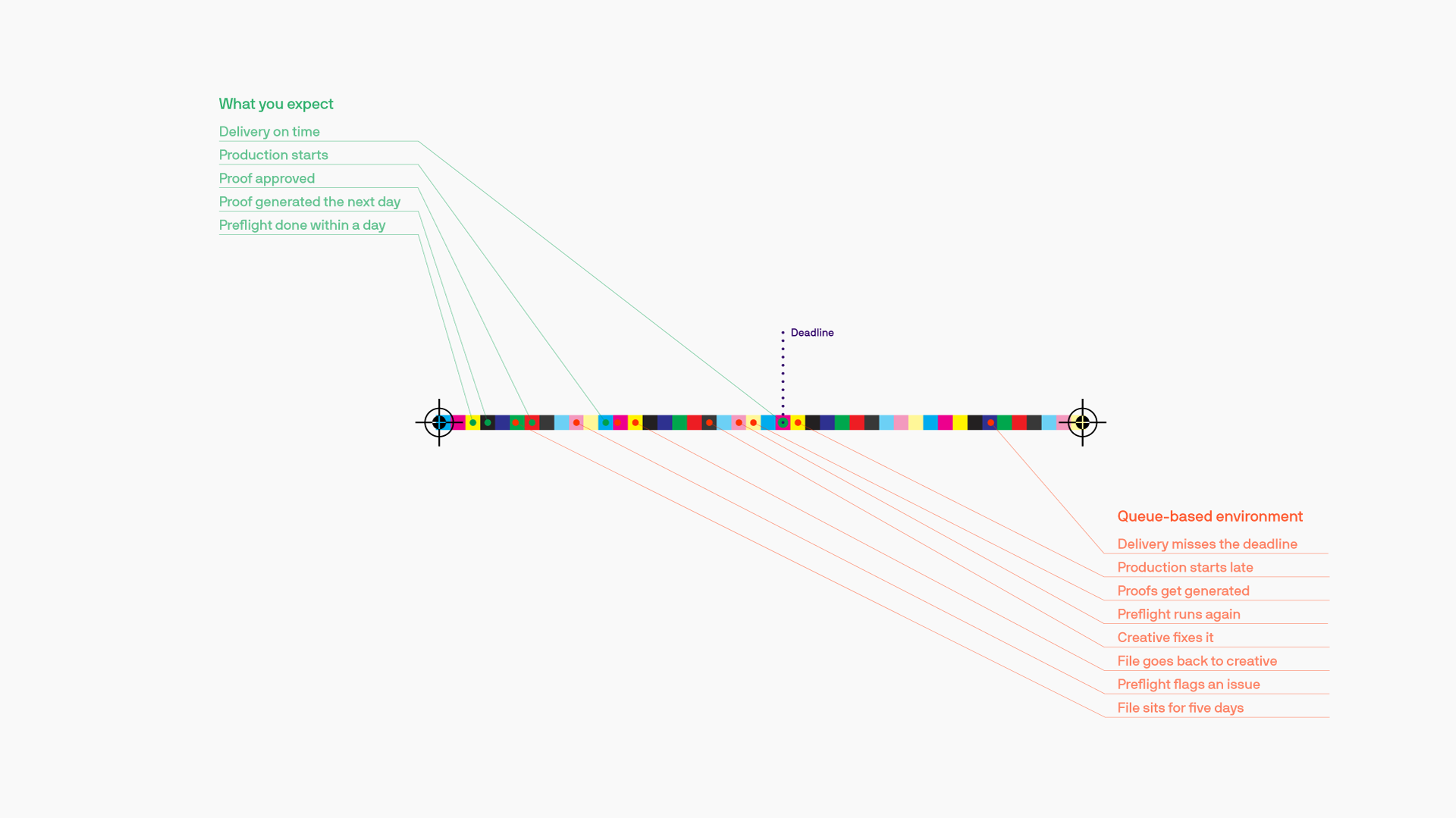
It’s day four after your creative team handed off the artwork file. No proof has arrived. No status update. You follow up with your vendor and learn the file hasn’t been looked at yet – it’s in the queue. Preflight hasn’t started. Which means proofing hasn’t started. Which means the production clock you’ve been counting on hasn’t started either.
You were given four weeks for production. You’ve just lost five days before a single sheet ran through a press.
The clock your team thinks is running isn’t
When a procurement lead, ops manager, or supply chain team receives a production timeline, that timeline almost always starts from one place: proof approval. Four weeks to delivery means four weeks from the moment you sign off on the proof. What it rarely accounts for is how long it takes to get to a proof in the first place.
That gap between file submission and validated proof is where preflight timing risk lives. It is one of the most consistent sources of avoidable delay in print production, and one of the least visible until it has already cost you something. For most brands working with traditional print vendors, that gap is invisible until it becomes a problem.
The creative who handed off the file assumes things are moving. The procurement person is watching a calendar, counting four weeks from a date that hasn’t actually started. Nobody connected those two realities. Nobody disclosed the gap.
Why vendor inconsistency makes this worse
Not every vendor handles this the same way. Some validate files within hours. Others batch their reviews where files go into a queue and get checked when a technician gets to them, which might be the next morning or might be the end of the week. There is no industry standard. There is no disclosed timeline.
This creates a specific problem: the last fast vendor sets the benchmark for every vendor that follows. If your previous printer turned preflight around in a day, that’s your mental model. Five days feels like something is wrong – but you don’t know if something is wrong, or if this is just how this vendor works, or whether following up will change anything.
A packaging run for a seasonal product launch is an unforgiving example. If the file submission to preflight validation gap runs four or five days, and the file comes back with a dieline mismatch that requires a creative revision (and a second round of validation), a four-week production timeline can realistically become six – after which the launch window may have closed entirely.
The uncertainty compounds the delay. By the time you confirm the file hasn’t been touched, you’ve lost days to the delay itself and more time navigating the ambiguity around it.